


Mexico '86: The World Cup That Made Me Fall in Love with Football
Every football fan has that one World Cup that gets them hooked. The one that turned football from something you watched into something you felt. For me, it was Mexico 1986.
I was eleven years old, and the World Cup might as well have been taking place on another planet. Mexico felt impossibly far away. There was no internet, no social media, no stream or instant video clips available, and certainly no 24-hour sports channels analysing every blade of grass. The World seemed a much bigger place back then. We relied on live television, highlights, newspapers, and conversations in the playground. The anticipation between matches only made everything seem bigger, more magical.
Mexico was not just a host nation. To me, it was a place of colour, noise and mystery.
The crowds seemed brighter than anything I had seen before.
There was Pique too, the Mexican World Cup mascot shaped like a jalapeño pepper, complete with sombrero and moustache. I had a small version of Pique from a Kinder Egg, which at the age of eleven felt like owning a tiny piece of the tournament itself!

Then there was the ball. The Adidas Azteca, which to me remains one of the most iconic footballs ever made (maybe second only to the 1990 Etrvsco Unico). Its black-and-white design, inspired by Aztec art, which even now, one glimpse of it takes me straight back to that summer.
The Azteca stadium also provided the perfect stage. Huge, intimidating and steeped in history, it looked almost mythical on television. It was not simply a football ground. It felt like the centre of the world.
The soundtrack mattered too - The ITV theme tune became inseparable from the tournament and later lived on through The Saint and Greavsie show. Hearing it today still unlocks memories of hot summer evenings, distant stadiums and the excitement of waiting for the football to begin.
Away from the television, the World Cup continued in the school playground. I had the Panini sticker album and, like everyone else, spent hours swapping duplicates - got, got, need...and trying to complete the pages.
I did managed to finish the England team and collected a fair number of the other players too, including Maradona. Some stickers, however, appeared far more often than others. I seemed to have at least ten copies of Ian Bridge and Terry Moore of Canada. They also had to share one sticker, which somehow made it feel as though I had twenty of them. Every playground had its impossible swaps, its prized possessions and its players nobody seemed to need.
Weirdly after England lost to Argentina, my Maradona sticker mysteriously disappeared...

The start of the England rollercoaster...
I remember England’s tournament began badly. I don't pretend to remember every intricate detail but know they opened with defeat against Portugal, drew with Morocco, with Ray Wilkins’ sent off - and suffered the huge blow of Bryan Robson being ruled out with a dislocated shoulder. Captain Fantastic was the driving force of the team, and seeing him forced out felt devastating. England had already started slowly, and now their leader was gone.
The pressure on Bobby Robson intensified. Yet he remained remarkably calm. While supporters and the press questioned the team, the tactics and England’s prospects, Robson maintained his cool demeanour. He never appeared to panic, even when the tournament seemed to be slipping away.
Then Gary Lineker stepped up...His hat-trick against Poland transformed England’s World Cup. Suddenly the team looked dangerous, a little bit of confidence was injected into both the team and the fans. Lineker followed it with two more goals against Paraguay and would eventually finish as the competition’s leading scorer - The Golden Boot winner.

In the space of a few days, England had gone from stuttering against so-called lesser nations to believing they might win the whole thing.
Emotion....That is one of football’s great powers.
But as the saying goes - It's the hope that kills you!
A Tournament of Stars...
Mexico '86 introduced me to players who seemed larger than life.
Laudrup, Platini, Careca, Butragueño - sadly Hugo Sánchez didn't score one of his spectacular overhead kicks! There were great teams, dramatic matches and unforgettable goals throughout the tournament.
But one player gradually came to dominate everything.
Diego Maradona always seemed to be lurking in the background during the group stages, influencing matches, going on mazy runs, scoring important goals. By the knockout rounds, the tournament belonged to him.
The Quarter Final...
England against Argentina was never going to feel like an ordinary quarter-final.
The Falklands War had taken place only four years earlier, and although I was aware of it, I was too young to understand the full political and emotional weight surrounding the match. I knew there was history. I knew there was tension. I knew many adults were treating it as something more than football.
Then came the Hand of God...
Maradona challenged Peter Shilton for a high ball and used his hand to knock it into the net. The referee missed it. England protested. The goal stood.
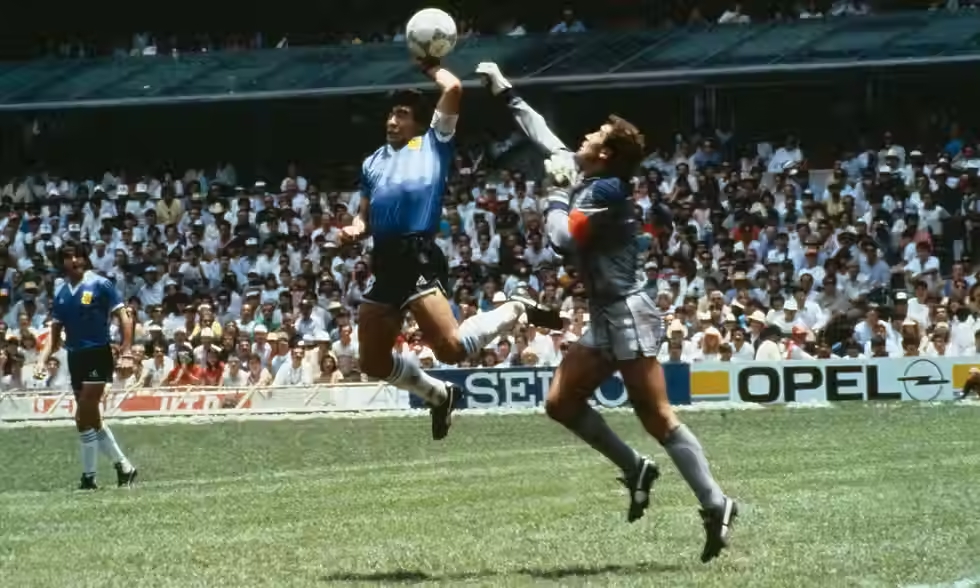
It was outrageous, infuriating and unjust.....A cheat in my young mind....
Yet only a few minutes later, Maradona produced something of brilliance...all be it aided by Peter Reid's running in treacle tracking back.....One by one, England players were left behind. Maradona continued through the defence, rounded Shilton and scored what is still widely regarded as one of the greatest goals in World Cup history.
Within the same match, he had produced one goal through deception and another through genius.
The first made him a villain....If you supported England.
The second made him immortal...unless you were English.
His brilliant solo goal against Belgium in the semi-final is now almost forgotten by comparison. It was another moment of extraordinary balance, control and imagination, but it had the misfortune to follow the greatest goal many people had ever seen.
That was Maradona at Mexico '86. He did not simply play in the tournament. He seemed to bend it around him...including his hand and the truth....bitter, me? Never...I couldn't bring myself to watch the final though.
What Would VAR Have Made of It?
Watching football today, it is impossible not to wonder how Mexico '86 would have looked under modern scrutiny.
Major matches are now covered by dozens of cameras. Every challenge, touch, movement and possible infringement can be replayed from multiple angles. Decisions are examined through slow motion, freeze frames and VAR reviews.
The Hand of God would have been disallowed (or would it?). How long would VAR have taken to reach the decision? Would the players have stood around for three minutes? Five minutes? Longer? Would the emotion of the moment have drained away while officials reviewed camera angles and discussed the obvious?
More interestingly, what would happen if every iconic goal from football history were placed under the same microscope? How many would survive? How many would be disallowed because of a fractional offside in the build-up, a minor push in the penalty area, a brushed hand or an almost invisible shirt pull? How many unforgettable moments would disappear because one of seventy cameras caught an incident nobody noticed at normal speed?
In my opinion Football is not meant played in freeze frames. Its beauty often lies in speed, uncertainty and emotion. The game has always been imperfect because it is played and officiated by human beings...In the strive for footballing perfection we seemed to have taken away part of it's soul.
Mexico '86 was full of those imperfections.
Perhaps that is one reason it remains so vividly in my mind.
From Mexico '86 to Mexico 2026
Forty years later, the story has returned to Mexico (shared now wit Canada and the USA).
It feels fitting that England have once again played at the Azteca, this time defeating the host nation in their own iconic stadium. For someone whose love of football began with images of that ground in 1986, seeing England triumph there feels like history circling back on itself.
Now Argentina stand in the way again.
This time there is no Maradona.
Instead, there is Lionel Messi, the only player since Maradona capable of inspiring the same sense that the impossible might happen whenever he receives the ball.
But England have match-winners of their own.

Harry Kane has spent years proving himself as one of the finest goalscorers of his generation. Jude Bellingham possesses the confidence, personality and quality to take control of the biggest occasions. England are no longer relying on one unlikely hero to rescue a stuttering campaign. They have players capable of deciding matches at the highest level.
For my generation, England against Argentina will always mean Maradona, the Hand of God, Peter Reid chasing shadows and the pain of Mexico '86.
For a younger generation, this World Cup semi-final may create a completely different set of memories.
Whatever happens in that match - and it may already have happened by the time you are reading this - hopefully it will inspire the next generation of World Cup memories. Somewhere, an eleven-year-old may be watching football turn from something they enjoy into something they feel. They may remember the players, the goals, the music, the stadiums and the heartbreak for the rest of their life.
Because that is what a World Cup can do.
It does not simply create champions.
It creates football fans for life.
Come on England....


Comments